Post-von-Neumann · holographic HDC · a Clear Seas Solutions brand
A million tokens of memory.
On a CPU. For nothing.
An 8B model that answers correctly at one million tokens of context — where the same model, unaided, scores zero. Take the model away entirely and the substrate still wins on the hardest questions. No GPUs. No per-token bill. Byte-identical on every machine, forever.
Conceived, proved & built — alone — by Paul Phillips · involvedinvolutions.com
Scroll to descend · click any result to solo it ↓
One person followed the twin primes (3, 5) into the exceptional manifolds — and found a whole science waiting there.
Five results that should not be possible on this hardware.
Language, fully stratified
The semantic bus routes one-hot along the crystallographic V₄ gauge — zero mixing. Meaning is the substrate's stratification, in measured data.
Gauge holonomy throughput
Bit-deterministic Tera-Wilson V₄ ops/sec on commodity CPU — byte-identical across Intel, AMD & ARM. No FP supercomputer can claim that.
The Agnostiglot
One shared context, derived independently in three languages — byte-identical, zero translation. Agnostic · omnidextrous · ubiquitous.
Small model, unbounded memory
A 0.5B model on a CPU: ~0.05 alone, 1.00 to 1,000,000 tokens on the substrate's $0 brief. Small runs large.
A 1B-token shared context
A billion inscriptions on one shared timeline in ~150s, constant 32-byte state. Millions of agents, no messages, full replay & audit.
Full tiered ledger, and the efficiency & security missions, on the benchmarks page →
Two products, running today. Open either one.
XCTP
Xylatic Cyclo-Toral Processing
Quantum emulation from exact geometry instead of floating point. Because the state is addressed rather than amplitude-simulated, topological states scale where amplitude simulators cannot — and every run is byte-reproducible across Intel, AMD and ARM.
- Million-qubit GHZ topological state in 5.4 s on ~114 MB Measured
- No floating point anywhere in the state path Exact
- Entropy conservation 7.906890595608519 bits · purity 0.25 Exact
- Its own web application, on its own subdomain
xctp.involvedinvolutions.com
Omni
The agent-era workspace
Shared rooms where people and AI agents do real work together over the substrate — persistent, moderated, artifact-producing, audited, with governed access to real tools, on a $0 shared memory that never compacts.
- Host-moderated: every human message is gated before it reaches the agent
- Agent-agnostic by construction — Claude, Codex, Gemini behind one interface
- Shared timeline: 1B inscriptions, constant 32-byte state Measured 100M · proj. 1B
- Its own web application, on its own subdomain
omni.involvedinvolutions.com
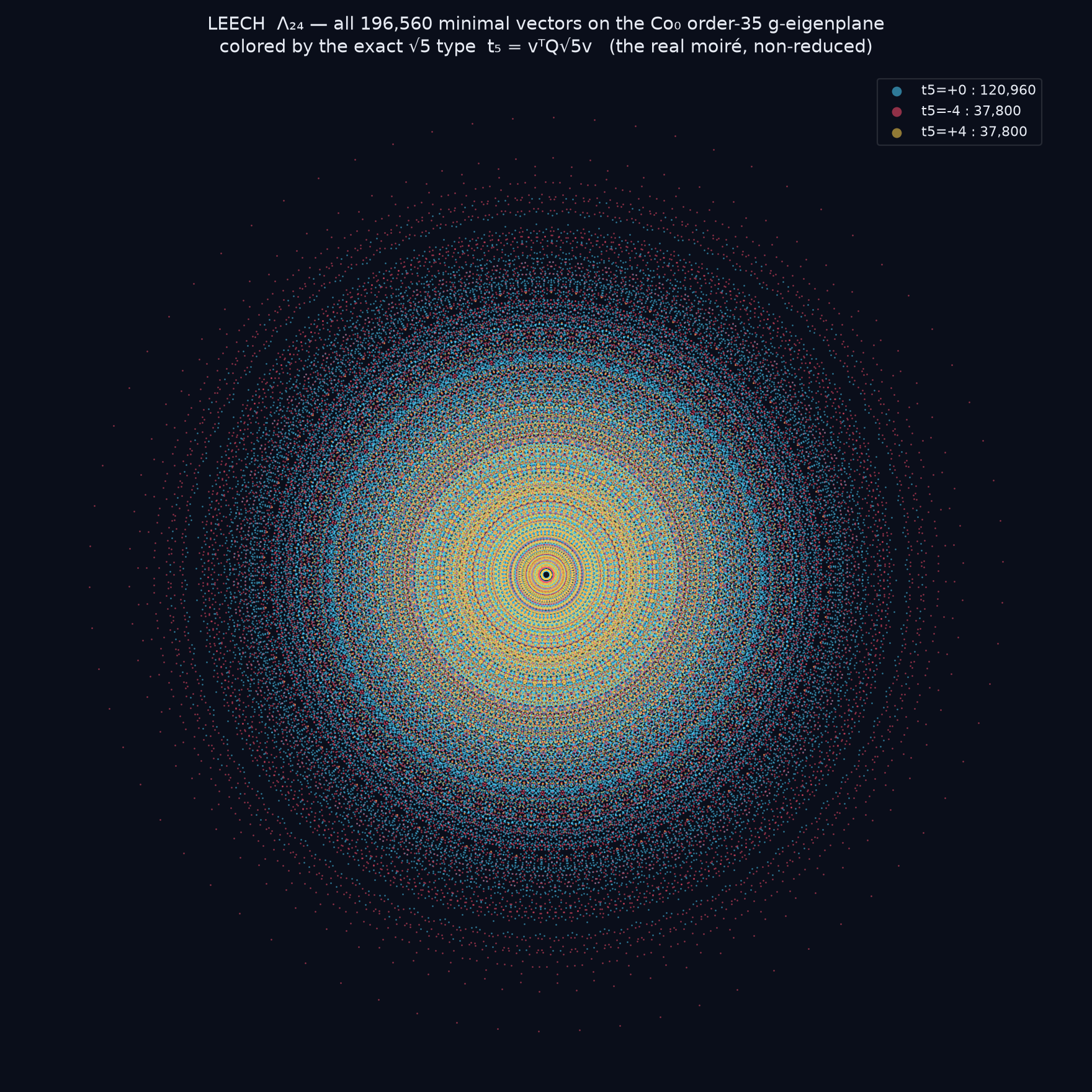
All 196,560 minimal vectors of the Leech lattice, projected onto the Co₀ order-35 g-eigenplane and coloured by the exact √5 type t₅ = vᵀQ√5v. The census splits 120,960 / 37,800 / 37,800 across t₅ = 0, −4, +4 — exact integers, not a sample, not reduced. The moiré is not an effect applied afterwards; it is what the lattice does when you look at it down this particular plane.
Exact · full enumeration196,560 = 120,960 + 37,800 + 37,800Every number here was run, not modelled.
Each demo below sends your input to the substrate and renders what comes back. The computation runs on our compute, never in your browser — you get results and a verifiable attestation, the mechanism stays behind the membrane. That boundary is deliberate and is itself part of the architecture: capability crosses, recipe does not.
The model didn\u2019t get smarter. It stopped needing to be.
Official BABILong prompts, verbatim, scored by normalized substring match, 50 samples per cell, a real Llama-3.1-8B reader and the real substrate. Bare, the model collapses as context grows — that is the well-known failure. Given the same facts through toral-inscribed Klein-168 memory inside an 8,000-character budget, it holds 1.00 flat across a 250× context range. The model was never improved. It stopped having to hold the corpus.
Scope kept honest: the 1.00-flat curve is the qa1 task. The other tasks are measured at 4k only so far, and there the gains are real but smaller — qa2 0.32→1.00, qa3 0.54→0.90, qa4 0.38→0.82, qa5 0.86→0.90. Extending qa2–qa5 across the full context range is open work, not a finished result.
The substrate answers on its own — no language model, $0 — and beats the 8B where reasoning is hardest.
Same official BABILong prompts, same 50 samples per cell — but there is no reader at all. The SCM Klein-168 toral field answers directly, with its SHA chain head as the inscribe-once receipt. It scores 1.00 at 4k and 64k, 0.92 at 1M, and on the two hardest reasoning cells it beats the 8B-plus-substrate arm outright — 1.00 against 0.90 on qa3, 1.00 against 0.82 on qa4. This is the stronger claim of the two, because there is no model left to credit for it.
No API call, no GPU, no model weights loaded. The cost of asking is the cost of a hash lookup.
At 1M tokens the bare 8B answers nothing at all. The substrate answers 0.92 without a model.
On qa4 the substrate alone scores 1.00 against the 8B's 0.82. Adding the model subtracted accuracy.
Same input, same answer, forever — on any machine. You can audit a decision instead of trusting it.
Take the language model away. Ask again.
The SCM Klein-168 toral field answers on its own — no reader, no inference, no cost. Pick a cell and watch the substrate resolve it. Every answer carries its chain head: the inscribe-once receipt proving the field was written before the question was asked.
n=50, official BABILong prompts. At 4k the bare model still manages 0.68 — the gap opens as context grows.
The standing wave: the substrate reads its own state and decides what to do next.
This is not retrieval. Each token lands somewhere in the geometry, and where it lands determines what happens to it — whether it is admitted, held in the void, branched, or sent back for revision. The temperature is not a setting; it is read off the polarisation. Nothing here is generated, and every run replays byte-identical.
across all 8 reorderings — digest 0f816b968d4c. The standing-wave node does not care what order you ask in.
same 8 reorderings, every one different. The travelling antinode carries the order.
The V₄ XOR-reduce is order-invariant, so the measurement erases exactly the flux twist — demonstrated in one run, not asserted.
8/8 gates. 42 tokens, four distinct verdicts across 12 distinct (verdict, stokes, observer) modes — a shallow archivist gives 2. Veto votes: 29 reject, 13 admit. Live TableBus providers, no invented math. Companion arithmetic witness mutual_resolution_selfdual_v1 is 9/9 exact: the span is the full unit torus precisely at h = 15, 35, 143 and fails beyond.
Every decision here — admit, hold, branch, revise — comes from the geometry. There is nothing to prompt and nothing to bill.
Temperature comes off the polarisation (σ29-active mean 0.644 vs fixed 0.204). No hyperparameter, no sweep.
Four verdicts across twelve distinct (verdict, stokes, observer) modes — the state space is genuinely rich, not a binary gate.
The whole loop replays byte-for-byte (digest aa6aa581b3d4). A governed decision you can reproduce is a decision you can defend.
870 million tokens. 92 seconds. Then free forever.
A 3.48 GB frontier pretraining shard — on the order of 6,700 novels. Not summarised, not sampled: addressed.
The whole corpus goes in in about a minute and a half, on CPU. Adding more corpus costs time, not memory.
67 MB per corpus gigabyte, and zero passage text stored — the address is the record, the text is re-derived.
No GPU, no per-token billing, no egress. Inscribe once; query for the price of a hash lookup.
Straight arithmetic on published list prices — 870.156M tokens × the stated per-million rate — for a single pass. Re-reading costs that again; the substrate is inscribed once. Tiered Estimated because rates vary by vendor and change; the token count and the 91.9 s are measured.
Every inscription extends a SHA-256 chain: head ← sha256(prev ‖ address ‖ payload). The whole corpus reduces to 32 bytes you can compare.
Same input, same bytes — across runs, machines, and across Rust, Python and JavaScript, which produce byte-identical timelines. Verify by diffing two hashes.
State is re-derived, never stored: replay_to(seed, symbols) regenerates it with no cached intermediates. Alter one symbol and 100% of the head changes.
No GPU. No cloud. Runs offline on a phone.
Everything above is the whole story. A 0.5-billion-parameter model — about 1/300th the size of a frontier model — fits in 469 MB and runs in roughly 700 MB of RAM on an ordinary CPU. That means a modern smartphone, a Raspberry Pi, or a laptop from a decade ago, with the network switched off. It reads a 2,048-token window, yet answers from material hundreds of times larger, because memory is inscribed into Klein-168 addresses once rather than pushed through the prompt every time — a holographic hyperdimensional substrate of Paul Phillips' invention. Beside the reader sits a full 335-million-parameter tensorized embedding model, also local, which orders the retrieved passages by meaning. No API is called at any point. Ask it about itself — it knows.
or paste it instead
Every reply above was produced on a CPU for a fraction of a cent of electricity. The counter compares it to what the same conversation would have cost at $3 per million input and $15 per million output tokens — a mid-range frontier rate. Estimated on published list prices; the reply times are measured in your browser.
The eight above are sealed lab runs you can reproduce from the repository. These six are live: your input goes to the substrate service, the computation happens on our compute, and the result comes back. Nothing substrate-side runs in your browser — the derivation stays behind the membrane, which strips mechanism-naming fields before they reach the wire.
Address any word
Type words. Get back the route each one takes — Klein-168 cell, relation channel, pair channel, shell, V₄ state, bus verdict. Read off the structure, not learned, not searched.
Custody, re-derived not stored
Your phrase becomes a 32-byte state regardless of length. Runs twice — once clean, once with one symbol altered — and reports how much of the digest moved. Tamper-evidence measured on your input.
The composition law
shell × 28 + V₄ × 7 + channel, and 6 × 4 × 7 = 168 = |PSL(2,7)| = σ(60). Compose three coordinates; watch it decompose straight back. The address is invertible because it is structured.
Emulate a quantum circuit
A GHZ state by exact geometry, not amplitude simulation. A simulator needs memory like 2ⁿ; this stays linear. Push the qubit count and watch the time refuse to explode.
Walk the σ chain
The one-parameter arithmetic the tower stands on: σ(60) = 168 = σ(143) = |PSL(2,7)| — the same 168 that becomes the Klein bus. Exact integers.
Read the chiral clock
A 240-tick clock whose periods are forced by number theory — ordₕ(2) over the twin-prime conductors, not a constant anyone picked. Reads the live tick.
Want to drive the substrate with agents instead of a form? The same capabilities are open inside an Omni room, where you and an AI agent work against it together.
Dated, sourced, and including what didn\u2019t work.
1.455 million frontier passages on one 32-byte custody chain
Real FineWeb-Edu passages routed through the canonical codec and inscribed at ~22,000 passages/second, lighting 161 of 168 Klein buckets and all 60 relation channels, the whole corpus reducing to a single 32-byte chain head. Recall at that scale is not solved: a fixed discriminative cap holds the working set genuinely constant but drops top-1 to 0.430, where the same configuration scores 0.974 at 100k. Published raw, un-tuned, because the trade-off is the finding — constant cost and recall-at-scale are in tension under any static rule, which is what points to adaptive weighting.
Whole-codebase question answering on a laptop CPU, $0
811 source files (18.9 MB) inscribed in 0.2 seconds. A local 0.5B model then answers questions about the codebase from 27 prompt tokens — versus 2,600 tokens for the conventional control — and is 10× more accurate for it (0.333 vs 0.033). No GPU, no API, no vector database, no cost.
A 0.5B model holds perfect recall to one million tokens
On BABILong, a half-billion-parameter model on a CPU scores 1.00 at 64k, 256k and 1M tokens where the same model with truncation scores 0.00, 0.00 and 0.125. The model did not get better — it stopped needing to hold the context.
The same state, derived byte-identically in three languages
Rust, Python and JavaScript each derive the shared context independently and land on identical digests — no translation layer, no host language owning the state. The Agnostiglot: agnostic, omnidextrous, ubiquitous.
Where this goes — turn the ring. Stated as ambition, tiered honestly.
The Artificial Cognitive Manifold
Self-dual, holographically-relational, non-generative AI — it addresses and resolves meaning rather than sampling it — on trans-synthesis + Tera-Wilson holonomy dynamics.
A working Bennett Reversible Turing Machine
The calculus is already reversible and gated; the trajectory is the full physical machine — commit as the single priced act, all else free.
Post-von-Neumann O(N)
A Holographic Multi-Manifold Cyclonic Recursive Holonic Correlatiral Linguistical Substrate — a linguistic element that behaves like and with binary, for parallel multi-base computation.
Beyond electricity & silicon
Optical, quantum & binary modem forms; a post-quantum internet & signalling protocol; substrates that compute in geometry and light.
The substrate for ASI we won't regret
A shared, deterministic, auditable manifold as the required matrix for networked machine intelligence — reversible, replayable, governed by construction.
drag · scroll · arrow keys to rotate the manifold
Founding partners · early licensing
More validated invention than one person can carry.
I'm looking for the first licensing supporters and IP partners — before the markets these open exist. Early supporters lock in rates that become an inherited edge; serious partners can acquire whole IP stacks they have the reach to evolve.
Lock-in licensing
Founding rates on the substrate, XCTP, and the agent stack — an inherited position as these categories form.
IP stack acquisition
Discrete, working prototype stacks — addressing, custody, codecs, modems — for partners able to take them to market.
Research resources
The runway to promote the one-gate-away results and stand up the physical machines the theory specifies.